We Provide One-stop Power Supply Solution


We Provide One-stop Power Supply Solution
Hey everyone, Peter here. In my daily conversations with engineers, procurement specialists, and fellow industry folks, one topic consistently sparks questions: the difference between Class I and Class II power adapters. It's more than just a two-prong vs. three-prong plug debate; it's a fundamental distinction in safety philosophy that impacts design, application, and user safety.
Let's break it down in plain terms.
The Core Philosophy: Two Paths to Safety
Simply put, *Class I* and *Class II* define how a power adapter protects users from electric shock. They represent two equally valid but fundamentally different approaches.
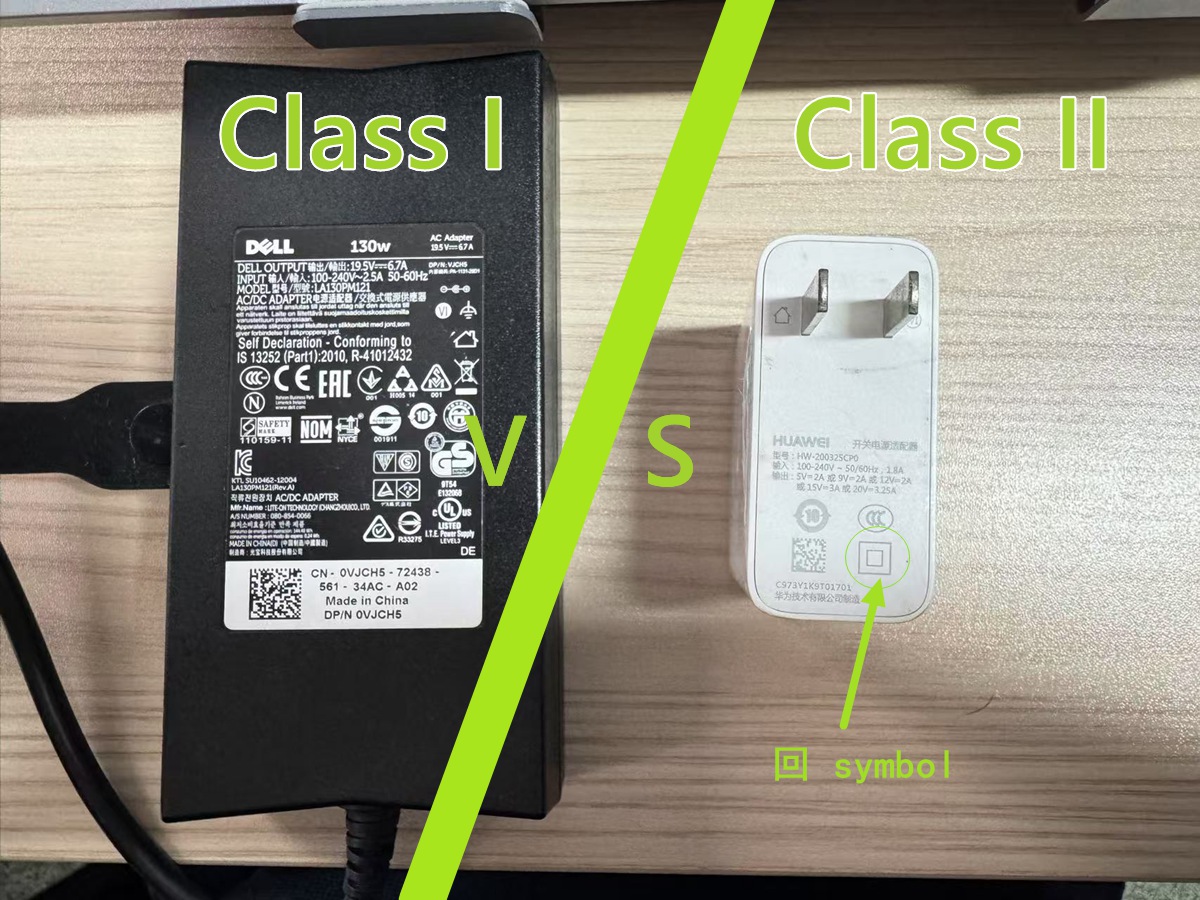
*Class I*: Safety through Grounding. Think of this as the 'escape route' method. These adapters have a third grounding pin (PE). If a live wire inside the adapter accidentally touches its metal casing, the current is safely diverted to the earth through this ground wire, preventing the casing from becoming electrified and shocking you. Its safety is dependent on a properly functioning building grounding system.
*Class II*: Safety through Insulation. This is the 'fortress' method. These adapters rely on Double or Reinforced Insulation—two independent layers of insulation (or one extra-robust layer)—to completely isolate all hazardous internal voltages from any user-accessible part. They do not require a ground connection. Their iconic symbol is the 'Double Square' or '回' mark, which is a mandatory legal identifier stamped right on the housing.
Here's a quick snapshot of how they stack up:
| Feature | Class I Power Adapter | Class II Power Adapter |
| Protection Principle | Relies on Protective Earth (PE) grounding | Relies on **Double/Reinforced Insulation |
| Plug Type | 3-pin (includes ground pin) | 2-pin (no ground pin) |
| Leakage Current | Max 0.75mA | Max 0.25mA |
| HI-POT Test | 1500VAC / 60 seconds | 3000VAC / 60 seconds (more stringent) |
| Label Marking | No 'Double Square' symbol | Must have the '回' symbol |
| Earth Resistance Test | Required | Not applicable |
Diving Deeper: Class I Adapters
How it Works & Best Uses:
Class I adapters are the go-to choice for higher-power devices or any equipment with a conductive (metal) enclosure. The grounding path ensures that if internal insulation fails, the metal shell never becomes live. You’ll commonly find them powering **larger laptops, industrial equipment, and many desktop monitors.**
Pros & Cons:
✅ Pros:Highly effective for metal-bodied devices; excellent safety when grounding is reliable.
❌ Cons:Safety is fully dependent on a good ground connection. In older buildings or with faulty outlets, the protection vanishes. They also tend to be slightly bulkier due to the grounding pin and internal connections.
Diving Deeper: Class II Adapters
How it Works & The Crucial '回' Symbol:
A Class II adapter's safety is built into its physical construction. The 'Double Square' (回) mark isn't just a logo—it's a regulated promise. It tells you the adapter has passed rigorous tests (like the 3000V Hi-POT test) and is legally certified to be safe without a ground. This makes it incredibly versatile and reliable. They are ubiquitous in phone chargers, tablet adapters, Bluetooth device docks, LED lamps, and critical applications like small medical devices where ground reliability can't be guaranteed.
Pros & Cons:
✅ Pros:
Ground-Independent Safety: Perfect for travel, older homes, or outdoor use where grounding is suspect or absent.
More Compact & Portable: No ground pin allows for smaller, lighter designs.
Inherently Lower Leakage Current:** Reduces potential interference and is often preferred for sensitive electronics.
❌ Cons: Requires higher-cost insulation materials and more precise manufacturing. If the physical insulation is damaged (cracked, pierced), the primary protection barrier is compromised.
The Practical Guide: How to Choose?
As a sales rep, my advice is always to match the adapter to the device and the environment. Here's a simple flow:
1. Check the Device Manual First. The OEM specification is law. Many devices, especially medical or portable electronics, are designed for Class II power.
2. Assess the Environment.
For modern, well-grounded offices/factories, Class I is often perfectly suitable.
For travel, older buildings, or variable environments, Class II is the safer, more robust choice as it doesn't gamble on ground quality.
3. Look at the Device Housing.
Metal/Conductive Enclosure? Use a Class I adapter and always ensure it's plugged into a properly grounded outlet.
Plastic/Insulated Enclosure? A Class II adapter is typically sufficient and offers greater flexibility.
Critical Warnings from the Field:
Do NOT Mix and Match Casually. While a Class II adapter can often power a device meant for Class I (if ratings match), the reverse can be dangerous. Using a Class I adapter on a device designed for Class II removes its ground-independent safety. If the ground is bad, the device casing could become live.
Always Look for Certifications. Safety isn't a claim; it's a certification. Look for marks from UL, CE, CCC, etc., which validate the Class I or II rating.
Respect Physical Damage. Frayed cables, cracked casings, or loose plugs compromise safety for both classes. Retire damaged adapters immediately.
The Bottom Line
Choosing between Class I and Class II isn't about which is universally 'better'—it's about applying the right safety tool for the job. Class I offers excellent, cost-effective protection where a reliable ground is present. Class II, marked by its trusted '回' symbol, provides a higher degree of inherent, portable safety that is immune to grounding issues, making it the indispensable choice for our modern, mobile world.
Understanding this distinction helps you make informed decisions, ensure compliance, and ultimately, design and use safer products.